Ever feel like you’re running on autopilot? You reach for your phone and start scrolling without thinking. You grab a cookie with your afternoon coffee, even when you’re not hungry. These actions aren’t decisions so much as they are ingrained scripts, running in the background of your life. You want to change, to build better habits, but you feel stuck in these patterns, unsure how to break free. What if you could understand the hidden engine driving these behaviors? What if you had a map to deconstruct and rebuild them? The good news is, you can. The answer lies in understanding a simple but powerful framework: the habit loop. This neurological loop is the foundation of every habit you have, and learning how it works is the first step toward taking control.
The Science Behind Your Habits: A Look Inside the Brain
Why do our brains work so hard to turn our actions into habits? The answer lies in efficiency. Our brains are constantly looking for ways to save effort. When a behavior is new, our prefrontal cortex, the part of the brain responsible for decision-making, is heavily involved. But as we repeat that behavior in the same context for a reward, the brain hands over control to a more ancient, primitive part of the brain: the basal ganglia.
Meet the Basal Ganglia: Your Brain’s Habit Center
The basal ganglia are a cluster of neurons located deep within the brain. Their job is to recognize patterns and automate them. Think of it like your brain’s autopilot system. When the basal ganglia take over, your conscious mind is free to focus on other things. This process is called “chunking”. The brain converts a sequence of actions into an automatic routine, a single “chunk” of behavior that can be triggered by a cue.
This is why you can drive to work without consciously thinking about every turn, or brush your teeth while your mind wanders. The basal ganglia are running the show, executing the habit script efficiently and automatically. This is a fantastic evolutionary advantage, but it’s also why bad habits can be so difficult to break. They are literally wired into our brains.
Deconstructing the Habit Loop: Cue, Routine, Reward
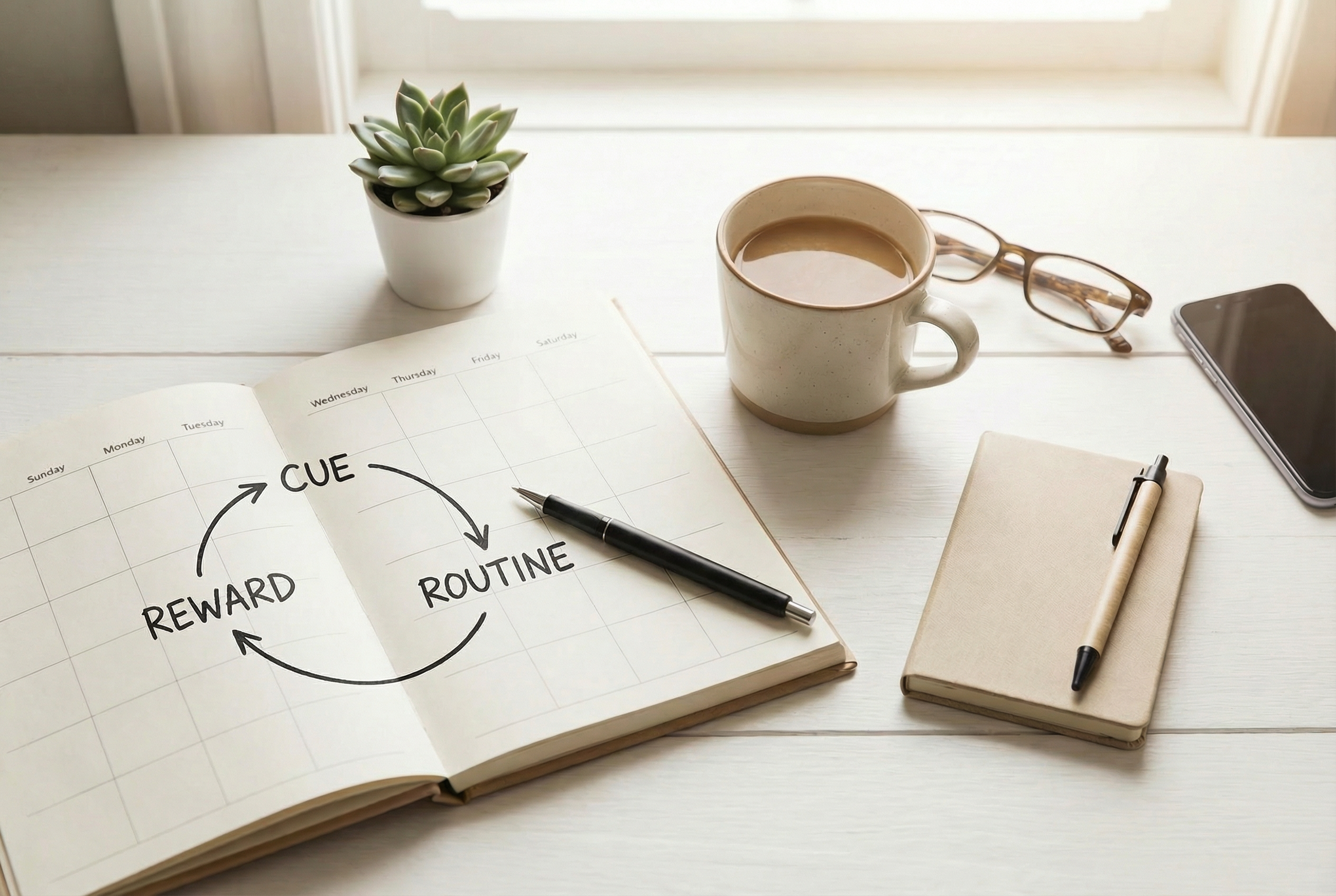
In his groundbreaking book, The Power of Habit, Charles Duhigg popularized a simple three-step model that explains how this process works. Every habit, good or bad, follows this same neurological pattern.
“This process within our brains is a three-step loop. First, there is a cue, a trigger that tells your brain to go into automatic mode and which habit to use. Then there is the routine, which can be physical or mental or emotional. Finally, there is a reward, which helps your brain figure out if this particular loop is worth remembering for the future.” - Charles Duhigg
Let’s break down each component in detail.
1. The Cue: The Trigger of Your Habit
The cue is the spark that sets your habit in motion. It’s a trigger that tells your brain to go into automatic mode and which habit to use. Cues can be almost anything, but they generally fall into one of five categories:
- Time: A specific time of day is one of the most common cues. Your 3:00 PM slump might trigger a craving for a sugary snack. Your alarm clock in the morning cues you to start the coffee maker.
- Location: Your environment plays a huge role in your habits. Walking into your kitchen might cue you to open the fridge. Sitting on your couch might cue you to turn on the TV.
- Preceding Action: One action can become the cue for the next. Finishing dinner might cue you to have dessert. Getting into your car might cue you to buckle your seatbelt.
- Emotional State: How you feel can be a powerful cue. Feeling stressed might trigger you to bite your nails. Feeling bored might cue you to check social media.
- Other People: The people around you can also trigger your habits. Seeing a coworker go for a coffee break might cue you to join them. Your friends ordering a round of drinks might cue you to do the same.
Identifying the cue is the first and most critical step in changing a habit. If you don’t know what triggers your routine, you’ll be fighting a losing battle.
2. The Routine: The Habit Itself
The routine is the behavior you perform, the habit itself. It can be physical (biting your nails), mental (worrying about the future), or emotional (lashing out in anger). The routine is the most obvious part of the habit loop, but it’s often the result of the cue, not the cause of your behavior.
When we try to change a habit, we often focus all our energy on stopping the routine. We try to use willpower to resist the urge to smoke or to force ourselves to go to the gym. But without addressing the cue and the reward, this approach is often doomed to fail.
3. The Reward: The Reason Your Brain Remembers
The reward is the final and most important step in the habit loop. The reward is what tells your brain that this particular loop is worth remembering for the future. When you get a reward, your brain releases dopamine, a neurotransmitter associated with pleasure and motivation. This dopamine hit reinforces the connection between the cue and the routine, making it more likely that you’ll repeat the behavior in the future.
Over time, as the habit becomes more ingrained, the reward itself becomes less important. What becomes more important is the craving for the reward. The cue starts to trigger a craving for the dopamine hit that the reward provides. This is why you can start to crave a cigarette just by seeing a pack of cigarettes (the cue), even before you’ve lit up (the routine).
How to Redesign Your Habit Loops
Understanding the habit loop is one thing, but how do you actually use it to change your behavior? The key is not to try to eliminate a bad habit, but to redesign it. This is what Duhigg calls the Golden Rule of Habit Change.
The Golden Rule of Habit Change: You can’t extinguish a bad habit. You can only change it. To change a habit, you must keep the old cue, and deliver the old reward, but insert a new routine.
Here’s a step-by-step guide to applying the Golden Rule:
Step 1: Identify Your Routine
This is the easy part. What is the habit you want to change? Be specific. Is it checking your phone first thing in the morning? Is it eating junk food when you’re stressed? Write it down.
Step 2: Experiment with Rewards
This is where you play scientist. The reward is often the hidden driver of your habit. You might think you’re craving a cookie, but what you’re really craving is a break from work, a change of scenery, or a moment of social connection. For the next few days, when you feel the urge to do your bad habit, try a different routine that delivers a different reward. For example, if your habit is getting a cookie at 3:00 PM, try one of these instead:
- Go for a walk around the block.
- Chat with a coworker for a few minutes.
- Do some stretching at your desk.
- Meditate for five minutes.
After each experiment, ask yourself: do I still feel the urge for the cookie? If the urge is gone, you’ve found your true reward.
Step 3: Isolate the Cue
Now it’s time to figure out what’s triggering your habit. Using the five categories of cues we discussed earlier, ask yourself these questions every time you feel the urge to do your habit:
- Where are you? (Location)
- What time is it? (Time)
- What’s your emotional state? (Emotional State)
- Who else is around? (Other People)
- What action immediately preceded the urge? (Preceding Action)
After a few days of tracking this, you’ll start to see a pattern. You’ll realize that you only crave a cookie when you’re at your desk (location) in the afternoon (time) and feeling bored (emotional state).
Step 4: Have a Plan
Once you’ve identified your cue, your routine, and your reward, you can create a plan to change your habit. The plan should be simple: When [CUE], I will [NEW ROUTINE] in order to get [REWARD].
For example:
- When it’s 3:00 PM and I’m feeling bored at my desk, I will walk over to my coworker’s desk and chat for five minutes in order to get a moment of social connection.
- When I get home from work and feel stressed, I will change into my workout clothes and go for a run in order to relieve stress.
Writing down your plan makes it more likely that you’ll follow through. It’s a simple but powerful way to take control of your habits.
How 3Act Helps You Master Your Habit Loops
Understanding the habit loop is the first step, but consistent tracking and accountability are what make change stick. This is where an app like 3Act can be a game-changer. By logging your actions daily, you create a clear record of your routines. This consistent tracking helps you easily identify the cues that trigger your habits and the rewards that reinforce them.
Are you trying to build a new morning routine? Tracking your habits with friends in a 3Act crew provides the social accountability you need to stay on course. The app’s automatic feed shows your crew when you complete your actions, creating a powerful sense of shared purpose. This external validation can be a powerful reward in itself, reinforcing your new, positive habit loop.
For those looking to break a bad habit, 3Act helps you implement the Golden Rule. Once you’ve identified your cue and reward, you can create a new, positive routine to track in the app. Every time you successfully complete your new routine, you get the satisfaction of checking it off in 3Act, earning XP, and maintaining your streak. This immediate positive feedback helps rewire your brain, making your new habit more automatic over time.
Changing habits is hard, but you don’t have to do it alone. With the right framework and the right tools, you can redesign your habits and build a life you love. For a deeper dive into the process of building new habits, check out our definitive guide on how to build a new habit.
Ready to Build Habits That Actually Stick?
3act is the free social habit tracker where your crew holds you accountable. Track your habits, share progress with friends, and never fall off again. With automatic accountability, streaks, XP, and a supportive crew by your side, your productive days start now. Download 3act free on the App Store →
References
[1] Duhigg, C. (2012). The Power of Habit: Why We Do What We Do in Life and Business. Random House.
[2] Graybiel, A. M., & Smith, K. S. (2014). Good habits, bad habits. Scientific American, 310(6), 38-43.
[3] Wood, W., & Neal, D. T. (2007). A new look at habits and the habit-goal interface. Psychological review, 114(4), 843.
[4] Lally, P., van Jaarsveld, C. H., Potts, H. W., & Wardle, J. (2010). How are habits formed: Modelling habit formation in the real world. European journal of social psychology, 40(6), 998-1009.